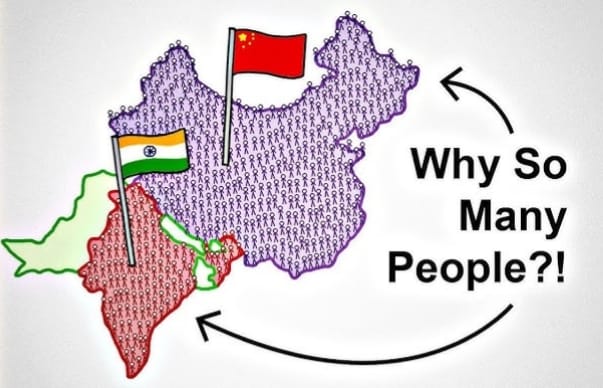
Why India and China Are Over-Populated: A Detailed Analysis
India and China, the two largest nations in Asia, together account for over one-third of the world’s population. Their enormous population sizes did not develop suddenly; instead, they are the result of centuries of historical patterns, cultural practices, economic transitions, and governmental policies. Understanding why these two countries are so heavily populated requires a deep look into their past, their social systems, and the developmental paths they have taken. Both nations share some common causes for high population growth, but they also have distinct historical and cultural factors that shaped their demographic trends.
1. Historical Continuity and Ancient Civilizations
One of the strongest reasons behind the huge population in India and China is their long and uninterrupted history of civilization. Both regions developed early agricultural societies more than 4,000–5,000 years ago.
The Indus Valley Civilization and later kingdoms in India supported large populations through advanced farming, trade, and irrigation.
Similarly, Ancient China built vast agrarian empires along the Yellow and Yangtze Rivers.
Because agriculture was stable, fertile land was abundant, and large families were needed for farming, populations in both countries consistently grew over centuries. Unlike regions that faced massive plagues, invasions, or geographical isolation, India and China maintained dense settlements generation after generation.

2. Agricultural Economy and Need for Large Families
For most of their history, both India and China were primarily agricultural societies. In such economies:
More children meant more labor for farms.
Families preferred having multiple children to ensure work in fields, take care of livestock, and maintain household responsibilities.
High child mortality rates in earlier centuries also encouraged families to have more children to ensure at least some survived to adulthood.
In India, rural traditions and joint-family systems further encouraged large households. In China, Confucian beliefs stressed family continuity and the importance of male heirs, pushing families to have more children.
3. Cultural and Social Norms
Cultural values played an important role:
Preference for sons in both nations led to higher birth rates because families kept having children until a boy was born.
Marriage at an early age, especially in past centuries, extended the reproductive years of women.
Religious and traditional beliefs in India often encouraged larger families as blessings.
In China, Confucian values placed family, lineage, and continuity at the center of society, naturally raising birth rates before the 20th century.
4. Decline in Death Rates After Modernization
A major demographic shift in both countries came in the 20th century when:
Medical facilities improved
Vaccines became common
Sanitation and clean water systems expanded
Hospitals and healthcare became accessible
This led to a rapid decline in death rates while birth rates remained high, causing a massive population boom. This phenomenon—called the Demographic Explosion—occurred in many developing nations, but the impact was far larger in India and China due to their already huge populations.
5. Limited Access to Family Planning (Initially)
Until the mid-20th century, effective birth control and family planning methods were not widely accessible in either country.
In India, awareness about contraceptives developed slowly, especially in rural regions.
In China, traditional family values kept birth rates high until the government intervened with strong policies.
It was only after the 1970s that both nations launched national family planning programs, but by then population numbers had already reached very high levels.
6. Government Policies and Economic Transitions
China
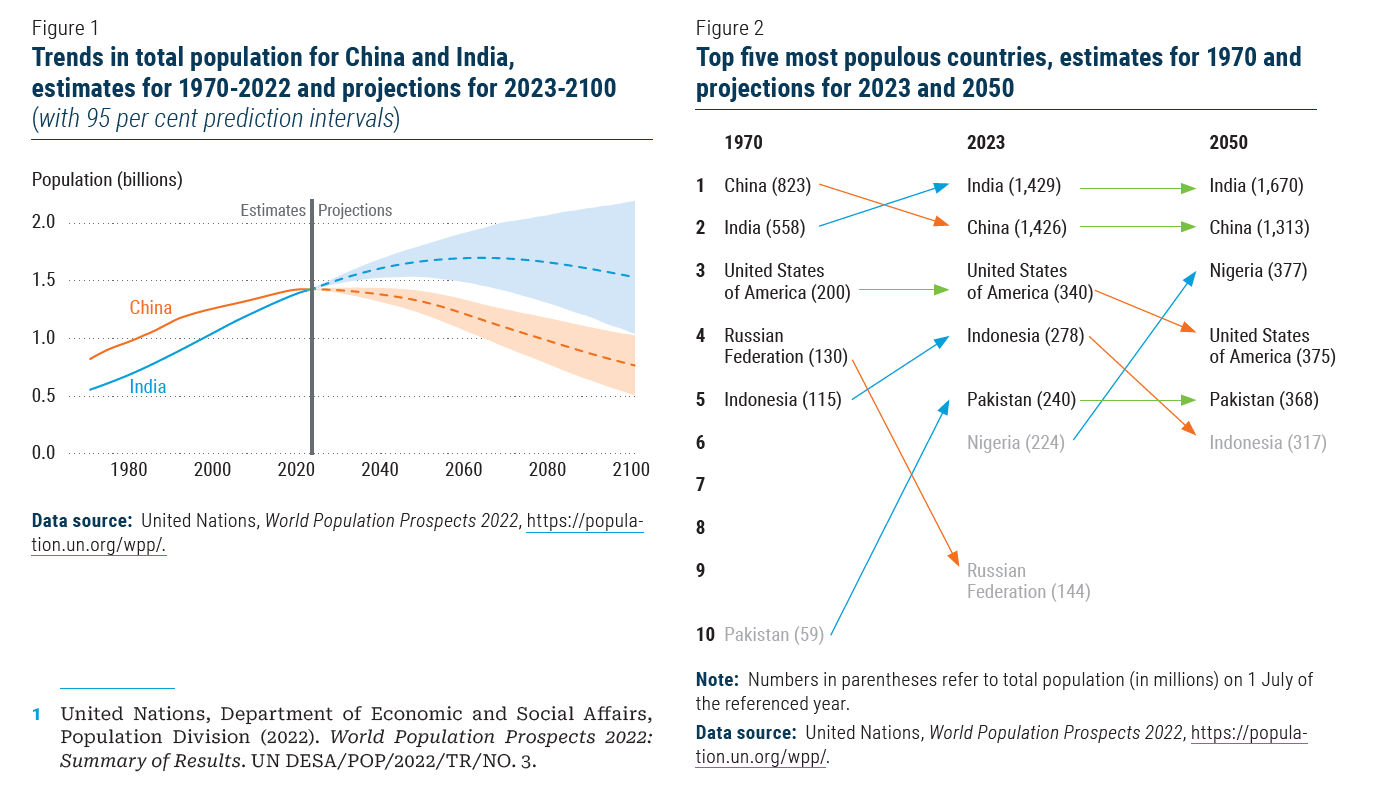
China saw exponential growth until the late 1970s. To control it, the government introduced the One-Child Policy in 1979, one of the strictest population control measures in history. While this drastically reduced birth rates, China had already crossed the one-billion mark. By the time they eased the policy, the population momentum was too strong.
India
India introduced family planning earlier, in the 1950s, but the program was not strictly enforced. India’s democratic framework also limited aggressive population control measures. As a result, India continued to grow rapidly. Economic liberalization in the 1990s improved healthcare and incomes, further reducing death rates, contributing to long-term population growth.
7. High Fertility in Rural Areas
A majority of India’s population and a significant portion of China’s older population lived in rural areas where:
Education levels were lower
Family planning awareness was limited
Children were seen as economic assets
In India especially, rural fertility rates were higher than urban ones for decades.
8. Population Momentum
Even after birth rates fall, a country with a large young population continues to grow. This is called population momentum.
Both India and China had:
Very large youth populations
Millions of women entering childbearing age each year
Even with lower fertility rates today, total population continues rising.
Conclusion
India and China are overpopulated not because of a single factor, but due to a combination of ancient civilizations, strong agricultural roots, cultural norms, historical lack of family planning, rising life expectancy, and demographic momentum. While both countries have made significant progress in reducing fertility rates and improving education, the population sizes remain massive due to centuries of consistent growth.
Today, both nations face unique challenges due to overpopulation—India struggles with unemployment and resource pressure, while China faces an aging population and shrinking workforce. Understanding the historical and cultural roots of their demographic patterns helps explain why these two nations became the most populated on Earth and how their future strategies may shape global development