Wind energy is regarded as one of the most effective renewable power sources, ranking just below solar energy in terms of cleanliness and sustainability. By 2014, wind power accounted for about 4% of global electricity demand, and its share has been increasing steadily. However, because wind turbines work best when they are large and installed at great heights—and because their large rotating blades are often considered unattractive—most wind farms are built in rural areas or offshore.
As a result, smaller wind power systems are rarely installed near towns and cities, where they could work alongside solar panels and other renewable technologies to supply extra electricity to homes and buildings, reducing dependence on centralized power grids. Fortunately, a French entrepreneur may have found a solution: a compact wind turbine designed to look like a tree.
What are wind-powered trees?
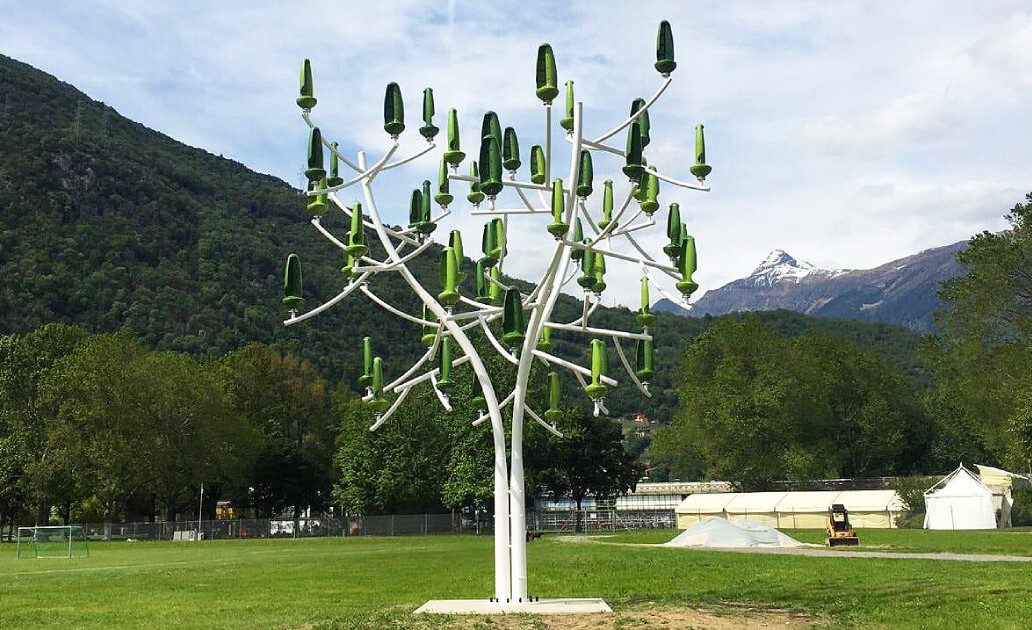
The device, commonly referred to as the “Wind Tree”—or “Tree Vent” in French—is an innovative form of wind turbine specifically designed for installation in urban environments. Unlike traditional wind turbines that require strong, steady winds and open spaces, this technology is tailored to function efficiently within cities, where wind flows are often weaker and disrupted by buildings, roads, and other structures. By capturing low-speed and turbulent air currents commonly found in urban settings, the Wind Tree has the potential to significantly expand the use of wind energy in densely populated areas.
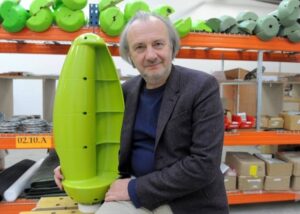
The concept was developed by Jérôme Michaud-Larivière, the founder of the French company New Wind, which later refined and commercialised the technology. His aim was to create a renewable energy solution that blends into city landscapes while producing clean electricity.
Each Wind Tree is equipped with 72 small vertical-axis wind turbines, known as Aeroleafs. These leaf-shaped turbines are specially designed to generate power from light breezes rather than strong gusts. The entire structure is approximately 11 metres (36 feet) tall and 8 metres (26 feet) wide, making it comparable in size to many trees commonly found in urban areas. According to Michaud-Larivière, the Wind Tree can begin producing electricity at wind speeds as low as 2 metres per second (about 7 km/h or 4.4 mph). This level of sensitivity is roughly twice that of conventional wind turbines, allowing the system to operate for more than 280 days a year in many locations.
Although it is designed to function in gentle wind conditions, the Wind Tree is also built to endure extreme weather. The structure is strong enough to withstand Category 3 storm winds, with speeds ranging between 178 and 208 km/h (111–129 mph). Each Wind Tree generates approximately 3.1 kilowatts of electricity. While this output may be modest when compared to large-scale wind turbines, installing several Wind Trees together—such as in parks, public squares, or green corridors between buildings—can collectively produce a substantial amount of renewable energy.
In addition, the Wind Tree has been engineered to operate silently, making it suitable for residential and public spaces. The specific arrangement of the Aeroleafs helps minimise vibration and noise, addressing one of the common concerns associated with wind turbines.
Each Aeroleaf is manufactured from lightweight plastic coated with a protective resin, which safeguards the turbines against challenging environmental conditions, including moisture, corrosion, and salt exposure. This makes the system particularly well-suited for coastal regions. The turbines are connected in parallel, meaning that if one Aeroleaf malfunctions or stops working, the remaining units continue generating electricity without disruption.
Overall, the Wind Tree represents a practical and visually appealing approach to producing clean energy in cities, combining durability, efficiency, and quiet operation in a compact, tree-like design.
Uses of Wind Tree
The device, called the Wind Tree (or Tree Vent in French), is a new kind of wind turbine designed specifically for urban environments. It aims to make wind energy more practical in cities by capturing low-speed winds that flow between buildings and along streets. The idea was developed by Jérôme Michaud-Larivière, founder of the French company New Wind, which brought the technology to the commercial market.
Each Wind Tree is equipped with 72 small vertical-axis turbines, known as Aeroleafs, which produce electricity from light winds. The structure is about 11 metres (36 feet) tall and 8 metres (26 feet) wide, roughly the size of a typical city tree. According to Michaud-Larivière, the Wind Tree can function in wind speeds as low as 2 metres per second (7 km/h or 4.4 mph). This makes it nearly twice as sensitive as traditional wind turbines, allowing it to operate for more than 280 days a year.
Although designed for gentle winds, the Wind Tree is built to endure Category 3 storm conditions, withstanding wind speeds of 178–208 km/h (111–129 mph). Each unit generates around 3.1 kilowatts of electricity. While this output is modest for a single unit, installing multiple Wind Trees in parks or open spaces between buildings can produce a significant amount of power. The turbines are also engineered to run silently, as their design minimizes noise.
Each Aeroleaf is made from lightweight plastic coated with protective resin, which protects it from extreme weather, moisture, and salt—making it suitable for coastal regions. The turbines are connected in parallel, meaning that if one Aeroleaf stops working, the rest continue to operate without disruption.