Mother of All Deals
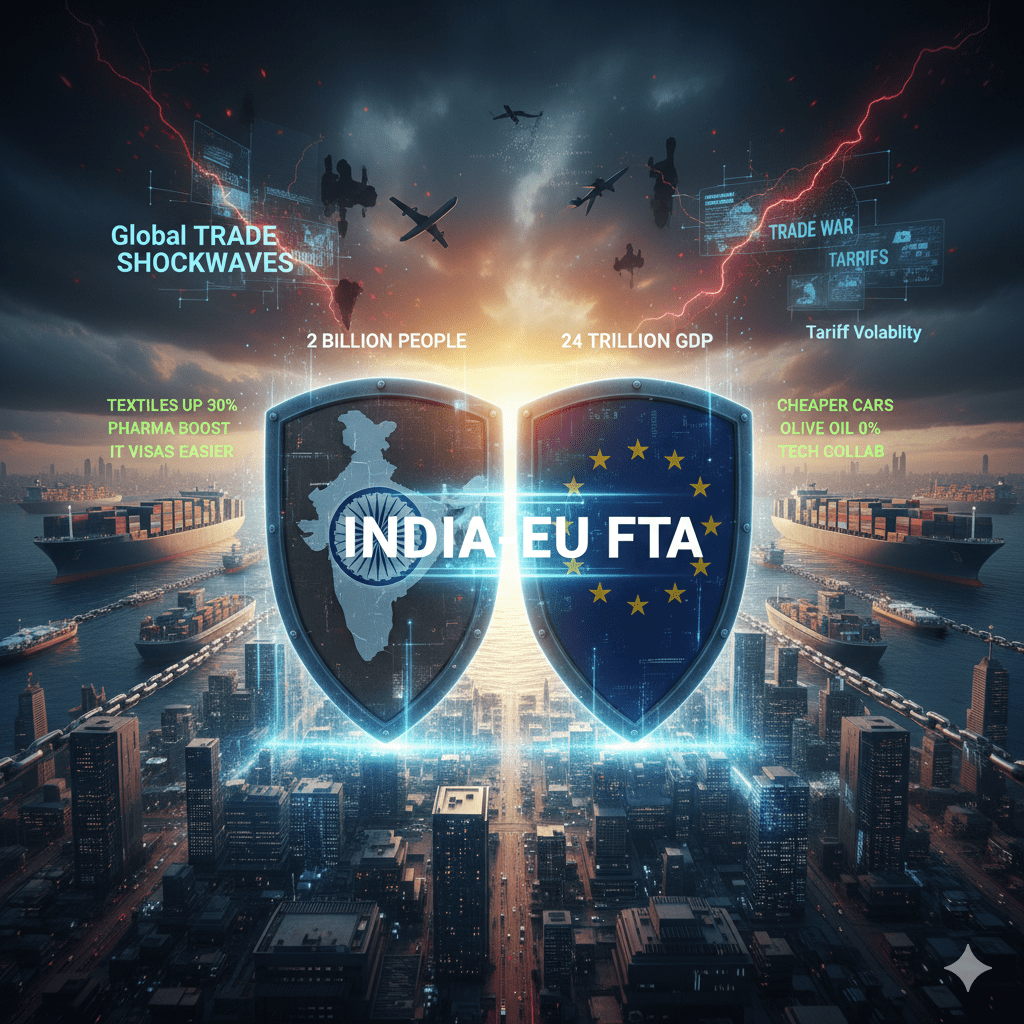
For nearly 20 years, the FTA was a sleeping giant of diplomacy. The deal, finalized during the visit of EU President Ursula von der Leyen and European Council President António Costa for India’s 77th Republic Day, creates a free-trade zone of 2 billion people. IN Mother of All Deals.
Key Statistical Highlights
Combined GDP: 25% of the global economy.
Trade Volume: Aims to double EU exports to India by 2032 and increase India’s exports by over ₹6.4 lakh crore.
Tariff Removal: Eliminates duties on over 90% of goods.
Pillar 1:
The Geopolitical Catalyst
Why did a 20-year stalemate break now? The answer lies in the Trump Factor.
US Tariff Pressure: With Donald Trump back in the White House and his America First agenda, including 50% duties on some Indian re-exports, both Brussels and New Delhi realized they needed a significant alternative market to guard against Washington’s unpredictability.
De-risking from China: Both countries are looking to shift supply chains away from Beijing. This FTA establishes a Zone of Trust for sensitive technologies like semiconductors and AI.
Strategic Autonomy: For India, this deal shows it can negotiate a top-tier trade pact with the West without sacrificing its main national interests.
Pillar 3:
Technology and Semiconductors
The deal isn’t just about wine and cheese; it’s about Silicon.
Semiconductor Fabs: The FTA reduces the cost of European chip-making equipment, like ASML’s technology, which is crucial for India’s ISM (India Semiconductor Mission).
AI Safety: A framework was signed to collaborate between the European AI Office and India’s National AI Mission, ensuring both countries set global standards for Human-Centric AI.
Quantum Computing: Talent exchanges will allow Indian scientists access to European research facilities.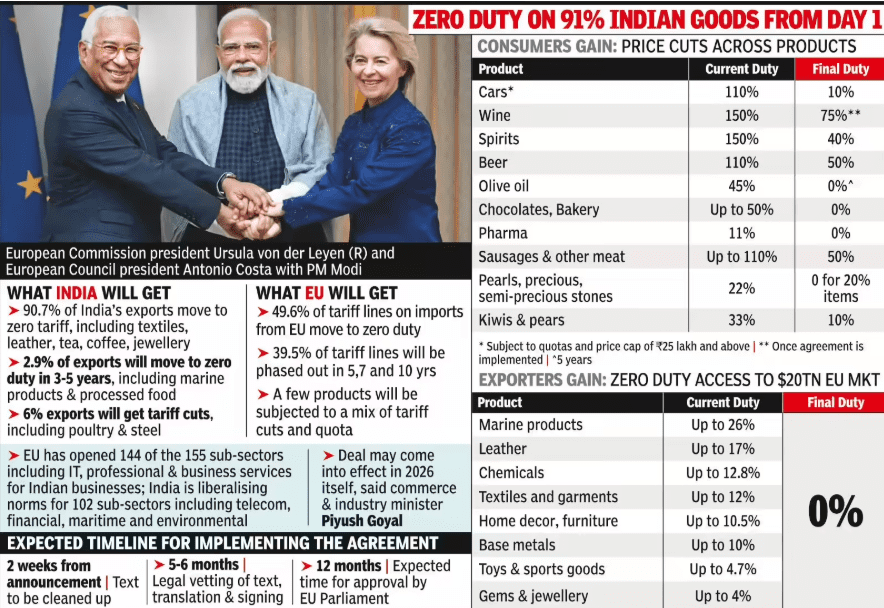
Pillar 4:
The Indian Export Boom
India’s labor-intensive sectors are the biggest winners.
Textiles & Apparel: Indian garments used to face 10-16% duties, making them pricier than products from Bangladesh or Vietnam. Now, with zero-duty access, hubs like Tirupur and Surat are expected to see a 30% rise in exports.
Seafood: Tariffs of up to 26% on Indian shrimp and fish have been removed, opening the €53 billion European market to coastal Indian states.
Professional Mobility (Mode 4): A big win for Indian IT. The deal simplifies visa processes for skilled professionals, allowing Indian engineers and consultants to work across 27 EU countries more easily in Mother of All Deals.
The Challenges:
The “Brussels Effect”
Despite the name, there are significant obstacles:
CBAM (Carbon Tax): The EU’s Carbon Border Adjustment Mechanism could tax Indian steel and aluminum exports if they aren’t green enough, possibly countering the benefits of tariff removal.
Traceability: Small farmers in India now need to geotag their land to prove they aren’t causing deforestation, leading to high compliance costs for rural areas.
Side Note: The Air India Deal
While the FTA is the Trade Mother of All Deals, the Tata-Air India deal stands out as the Corporate Mother of All Deals. In January 2026, Air India expanded its massive 2023 order of 470 planes by adding 30 more Boeing 737 MAX jets and upgrading to the Airbus A321XLR. This creates a global flying fortress for India, perfectly timed to support the surge of trade and people that the FTA will bring
WHY THE DEAL MATTERS FOR EUROPE
For the European Union, the agreement opens sustained access to one of the world’s fastest-growing major economies at a moment when traditional markets face stagnation. India’s demographic dividend, expanding middle class, and large-scale digital and manufacturing transformation offer European businesses long-term opportunities across sectors in Mother of All Deals
India’s offer covers over 92% of tariff lines, with phased liberalisation designed to allow domestic industry to adjust while encouraging investment and technology transfer. Access to India’s market for high-technology goods and advanced services is expected to diversify EU export destinations, reduce input costs for Indian manufacturers, and deepen integration into global supply chainsn in Mother of All Deals.
SERVICES, MOBILITY AND THE POWER OF TALENT
One of the most forward-looking dimensions of the India–EU FTA lies in services and mobility, sectors that will define global trade in the decades ahead. The EU has committed market access across 144 services sub-sectors, including IT and IT-enabled services, professional services, education, finance, tourism, and other business services—areas where Indian firms enjoy global competitiveness.Equally significant is the comprehensive mobility framework. By facilitating predictable and transparent movement of business visitors, intra-corporate transferees, contractual service suppliers, and independent professionals—along with provisions in Mother of All Deals.
for dependents—the agreement positions India firmly as a global hub of skilled talent. Commitments to student mobility, post-study work opportunities, and a framework for future social security agreements further strengthen people-to-people and knowledge-based economic ties.
The inclusion of provisions enabling practitioners of Indian traditional medicine to work in EU member states where regulations permit adds a uniquely Indian dimension to the partnership, reflecting cultural as well as economic confidencein Mother of All Deals.
A SIGNAL TO THE GLOBAL ORDER
Beyond tariffs and market access, the India–EU FTA sends a powerful message to the world. In recent years, India has signed or concluded major trade agreements with the UAE, Australia, EFTA, the UK, Oman, and New Zealand. The EU agreement, often termed the “mother of all deals,” sits at the centre of this strategy, effectively opening the broader European market to Indian exporters and entrepreneurs.
At a time when protectionism and economic nationalism are resurging globally, the India–EU FTA demonstrates that large economies can still choose cooperation over confrontation. It reflects confidence in India’s macroeconomic stability, regulatory predictability, and reform trajectory under Prime Minister Modi.
Aligned with the vision of “Viksit Bharat 2047,” the agreement positions India not merely as a market, but as a rule-shaper and trusted partner in global trade. For Europe, it anchors engagement with a growth engine of the future. For the world, it stands as evidence that open, balanced, and forward-looking trade agreements remain possible, even necessary, in an era of uncertainty in Mother of All Deals.
In that sense, the India–EU Free Trade Agreement is not just a trade milestone. It is a declaration of India’s economic moment—and a signal that the centre of gravity in global commerce is steadily shifting in Mother of All Deals.
Why the EU won’t budge on CBAM
While details will be known once the legal text becomes available, the EU’s uncompromising stance on the Carbon Border Adjustment Mechanism (CBAM) is not surprising. Minimising carbon emissions is fundamental to the EU’s vision of economic security. It is unfair to expect that it will necessarily accept India’s domestic price of carbon, as levied through fossil fuel taxes, as a nullifier for exempting CBAM-sensitive Indian exports—steel, aluminium, fertilisers, cement—from being taxed at the border. High carbon prices are the EU’s way of disincentivising emissions. Even if this is not agreed with, the economic security concern driving the idea must be respected.
The fine print will also have to be awaited for digital trade rules, especially on whether cross-border free flows of data from India are allowed by the EU. Like the CBAM, this is also an area where the EU red line is noteworthy. As of now, India is yet to be included among data locations considered secure under the EU’s General Data Protection Regulation, notwithstanding its implementation of the Digital Personal Data Protection Act.
The “Mother of All Deals” signifies India’s graduation to the top tier of global economic powers. It is a win-win: Europe gets a youthful, massive market, and India gets the technology and capital to become the world’s third-largest economy.