Sanchar Saathi , which was released in January, was designed to let users block and track lost or stolen phones and to identify and shut down fraudulent mobile connections. Since its launch, it has drawn more than 5 million downloads and helped recover more than 700,000 lost devices, according to government data.
Pahwa said the main concern is that the app’s role could eventually expand, giving authorities greater ability to “access device status.” He said the order also removes user consent as a choice.“Phones are our personal spaces. We have a choice to have what we want on them. Here the government is taking away that choice,” he said.
The order is also expected to face resistance from smartphone companies like U.S.-based Apple, whose internal policies prohibit preinstalling third-party apps on its devices, including those developed by governments.
5 points on Sanchar Saathi app
-What is Sanchar Saathi app:
Sanchar Saathi allows users to verify their device’s unique International Mobile Equipment Identity (IMEI) number and report any misuse. Officials said the app is crucial for tackling the “serious endangerment” to telecom cyber security posed by duplicate or spoofed IMEI numbers, which are often used in scams and network misuse.
–Why is Opposition criticising it?
Several Opposition leaders, including Congress MP Priyanka Gandhi Vadra, have raised ‘snooping’ concerns over the Sanchar Saathi app, saying the application infringes on the right to privacy of citizens. “The Sanchar Saathi is a snooping app, and clearly it is ridiculous. Citizens have the right to privacy. Everyone must have the right to privacy to send messages to family and friends without the government looking at everything,” Congress general secretary Priyanka Gandhi Vadra told reporters.
-Govt said in clarification:
Union minister for communications Jyotiraditya Scindia on Tuesday addressed the concerns flagged by opposition leaders and said that activation of ‘Sanchar Saathi’ app on mobile handsets is not mandatory and it is fully up to the consumers to use it or delete it like any other app, asserting that “digital security of every citizen of the country is our topmost priority”. The objective of the ‘Sanchar Saathi’ app is to enable each individual to protect their privacy and stay safe from online fraud, Scindia said in a post on X.
–Govt shares Sanchar Saathi perks:
Sharing how Sanchar Saathi app has helped people, Jyotiraditya Scindia said on X over 20 crore people have used the portal so far and over 1.5 crore users are connected to the application. Upon citizens selecting ‘Not My Number,’ over 1.43 crore mobile connections have been disconnected, Scindia said, adding that 26 lakh mobile phones have been traced, of which 7.23 lakh devices have been successfully returned to citizens.
What else the directive says:
Under the directive dated November 28, all original equipment manufacturers (OEMs) and importers have 90 days to install the app across their device line-up and an additional 30 days to submit a compliance report to the DoT. Manufacturers will also have to roll out software updates containing the app for all devices already produced, sold, or in the supply chain. The order, reviewed by HT, states that the app “must be visible at first use” and that “its functionalities cannot be disabled.” Officials noted that confusion over these clauses may have led to claims that the app couldn’t be uninstalled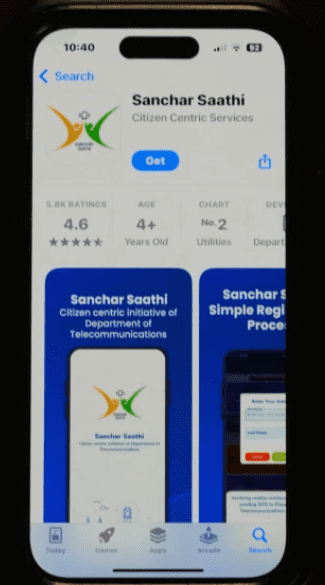
Phones in use must also comply
The app was launched at the start of 2025 and allows users to check their handset’s unique International Mobile Equipment Identity (IEMI) – the equivalent of a serial number. According to India’s Department of Telecommunications, mobile handsets with duplicate or falsified IMEI numbers pose “serious endangerment” to telecoms’ cybersecurity.
The app also means stolen phones can be tracked and the government said 700,000 lost smartphones have been found since Sanchar Saathi’s launch for voluntary use at the start of the year. The Guardian notes that Russia is also using the dangers of stolen phones as the reason for increased cybersurveillance of its population. In August President Putin’s government issued a similar requirement for the state-backed messenger app, Max, to be pre-installed on phones.
Owners of smartphones already in use are to given three months to install the app on their devices.
Attack on privacy?
Sanchar Saathi Naturally enough this has sparked a furore – the government has suddenly gaining the right to snoop on all smartphone owners and with no regard for privacy. The backlash finally prompted the Indian’s Minister of Communications, Jyotiradtiya Scindia, into explaining that the app is “a voluntary and democratic system” that mobile users can delete.
As the BBC and others have pointed out, it is not clear how they will exercise this option given that the government has said the functions “cannot be disabled or restricted”.
Smartphone makers are to “make an endeavour” to install the app via software updates for devices that have left the factory but are yet to be sold, the Indian government has said. It has also told the manufacturers to provide a compliance report with the order in 120 days’ time.
Reactions of smartphone makers are not yet public, but Apple in particular is known for pushing back against governmental efforts to gain access to iPhones and the activities carried on them. It has been a loggerheads with a number of regulators and has refused to comply some orders. iPhones accounted for about 4.5% of 735 million smartphones in use in India in summer this year according to Counterpoint Research.
CONCLUSION
We can’t see exactly what it’s doing, but we can see that it’s asking for a great deal of permissions – potential access to just about everything from flashlight to camera. This is itself worrying,” he told the BBC.On Google’s Play Store, the app says it doesn’t collect or share any user data. The BBC has reached out to the department of telecommunications with questions about the app and the privacy concerns related to it.
Mr Roy adds that compliance will be difficult, since the order runs counter to the policies of most handset-makers, including Apple.”Most companies prohibit installation of any government or third-party app before the sale of a smartphone,” he says.
While India’s smartphone market is dominated by Android, Apple’s iOS powered an estimated 4.5% of the 735 million smartphones in the country by mid-2025, according to Counterpoint Research.Apple has not commented publicly, but Reuters reports it does not intend to comply and “will convey its concerns to Delhi”.
India is not the only country to have tightened rules on device verification.In August, Russia ordered all phones and tablets sold in the country to come pre-installed with the state-backed MAX messenger app, sparking similar privacy and surveillance concerns.