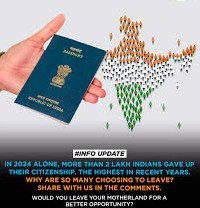
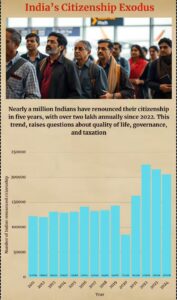
Nearly one million Indians have given up their citizenship over the past five years, with the annual number consistently exceeding 200,000 since 2022, according to data presented by the government in Parliament.
This trend has raised an important question: why are an increasing number of Indians—especially those who are wealthy or highly skilled—choosing to renounce their Indian passports?
In response to questions from Congress MP KC Venugopal in the Lok Sabha, the Ministry of External Affairs (MEA) stated that 206,000 Indians gave up their citizenship in 2024, following 216,000 in 2023 and 225,000 in 2022. In 2021, 163,000 renunciations were recorded, while in 2020 the number was the lowest in a decade at 85,256, largely due to disruptions caused by the Covid-19 pandemic.
Between 2011 and 2024, over 2.06 million Indians renounced their citizenship, with almost half of these cases occurring in just the last five years, according to data shared during the ongoing winter session of Parliament.
Venugopal asked whether the government had studied the reasons behind this growing trend and what measures were being considered to reduce the number of citizenship renunciations, particularly among younger Indians.
In recent years, several opposition leaders have raised concerns about what they describe as a growing trend of the “exit of the successful” from India. Prominent figures, including TMC MP Mahua Moitra, have questioned why an increasing number of people are renouncing their Indian passports. During a discussion on the economy, Moitra asked whether this trend reflected a “healthy economic environment” or merely a “healthy tax environment.” She further alleged that an “atmosphere of fear” created by the Enforcement Directorate (ED), with investigations disproportionately targeting opposition leaders and businesspeople, may be driving this migration.
Sanjaya Baru, former media advisor to Prime Minister Manmohan Singh, explored this issue in his book Secession of the Successful, suggesting that India is experiencing a fourth wave of emigration. This wave is characterized by the departure of high-net-worth individuals (HNIs), their families, and other elite professionals. Baru cited data from Morgan Stanley showing that approximately 23,000 Indian millionaires left the country between 2014 and 2023.
Opposition leaders have repeatedly asked whether this increasing outflow of wealth and talent is a sign of deeper concerns regarding quality of life, governance, education, taxation, and long-term security—issues that they believe might make developed economies more attractive in comparison.
MEA Cites “Personal Reasons”; Calls Diaspora an Asset
In a written response, Minister of State for External Affairs Kirti Vardhan Singh stated that the reasons why individuals renounce their Indian citizenship are personal and known only to those concerned. The Ministry of External Affairs (MEA) emphasized that the government acknowledges the importance of the global workforce in today’s knowledge-driven economy. It further noted that a successful and influential Indian diaspora is a valuable asset for the country. The MEA highlighted that the government’s priority is to actively engage with the diaspora and make use of its expertise and soft power, rather than discouraging Indians from acquiring citizenship abroad. Additionally, the ministry provided a record of 135 countries whose citizenship has been acquired by Indians, showcasing the widespread nature of this trend worldwide.
Main Point: No Dual Citizenship
One of the main reasons why many Indians choose to give up their Indian citizenship is the country’s policy against dual citizenship. According to Section 9 of the Citizenship Act of 1955, any Indian who voluntarily obtains citizenship of another country automatically loses their Indian citizenship. For Indians living abroad, citizenship can have significant implications, affecting their ability to vote, access social security benefits, obtain permanent residency, seek employment in the public sector, and receive legal protections. Although the Overseas Citizen of India (OCI) status offers certain advantages, such as visa-free travel to India and limited economic opportunities, it does not grant substantial political rights. Consequently, many long-term Indian migrants, particularly those who have families abroad, often find themselves with little option other than formally renouncing their Indian citizenship.
Who is departing, and for what reason?
Although there is no detailed data available by occupation, global research indicates that Indians represent one of the largest skilled migrant communities in the world. According to the United Nations, India has consistently been the leading source of international migrants, with a diaspora numbering 17.5 million as of 2019. In the United States alone, 81% of Indian immigrants aged 25 and older have at least a bachelor’s degree, a proportion that is significantly higher than both the native-born population and other immigrant groups, according to the Migration Policy Institute.
Migrants frequently point to factors such as higher wages, cleaner living conditions, reliable infrastructure, better civic services, strong education systems, and clearer routes to permanent residency and citizenship as motivations for moving abroad. For many individuals, obtaining citizenship represents the culmination of a long migration journey, one that often begins with pursuing education and employment opportunities in another country.