IndiGo Flights Cancellations Live Updates: IndiGo faces a major operational crisis, cancelling over 850 flights today, leaving thousands stranded. The aviation ministry has ordered refunds by Sunday and instructed baggage reunification and dedicated support cells. Congress blamed the government’s alleged push for a duopoly and rollback of pilot safety norms, calling it a government-made disaster
IndiGo Flights Delayed:
14 IndiGo flights cancelled at Goa’s Dabolim airport Passengers at Goa’s Dabolim Airport experienced severe inconvenience on Saturday as at least 14 domestic IndiGo flights were cancelled, including services to Mumbai, Delhi, Hyderabad, and Bangalore. Many cancellations were a
IndiGo flights cancelled live: Timeline for refund and baggage delivery
IndiGo flights cancelled live: Why is govt capping airfares?
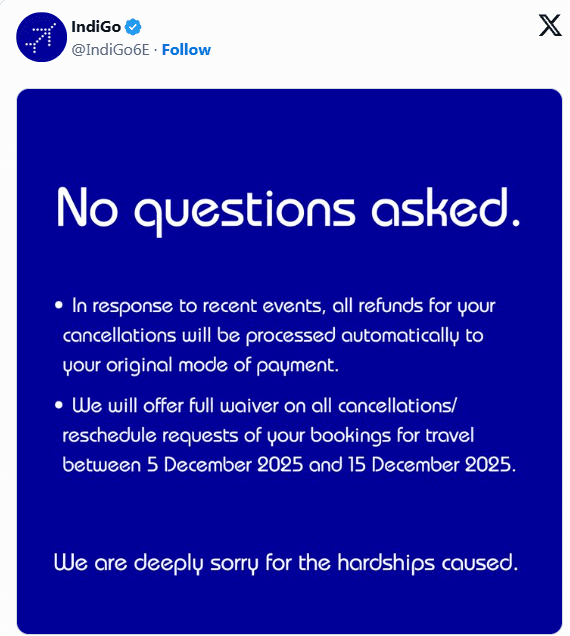
IndiGo flights cancelled live: IndiGo announces automatic refunds, waiver on cancellations
IndiGo Flights delayed: IndiGo adds resilience measures amid ongoing disruptions
The airline said it is taking steps to add “more resilience” to its processes to prevent further delays and minimise the impact on passengers. As part of these efforts, IndiGo is working with airports nationwide to strengthen coordination and streamline information flow, ensuring that travellers receive faster and clearer updates during the disruption period.
IndiGo flights cancelled live: Govt asks IndiGo to set up passenger support and refund facilitation cells
“These cells have been tasked to proactively contact affected passengers and ensure that refunds and alternative travel arrangements are processed without the need for multiple follow-ups.”
“The system of automatic refunds will remain active until operations stabilise completely,” the statement said.
IndiGo said customer refunds are being processed on priority and has urged passengers to check real-time flight status before heading to the airport. The airline is coordinating with airports and partner agencies to ensure timely updates via terminals, its website, and direct notifications. It advised travellers to verify the latest information on its flight-status portal as schedules continue to shift during the recovery phase.
IndiGo Flights delayed: Govt enforces nationwide fare caps after Indigo meltdown
The Centre on Saturday issued its toughest directive yet to stabilise India’s aviation sector, ordering all airlines to strictly comply with newly fixed maximum fare limits after air ticket prices soared to record highs amid the continuing IndiGo crisis. The Ministry of Civil Aviation said the emergency measure was necessary in “public interest” following massive flight cancellations, sharp capacity shortages and widespread passenger distress.
The government has introduced an immediate nationwide cap on domestic economy-class fares based on distance slabs:
- Up to 500 km: Rs 7,500
- 500–1000 km: Rs 12,000
- 1000–1500 km: Rs 15,000
- Above 1500 km: Rs 18,000
These fare ceilings exclude UDF, PSF and taxes. Business-class fares and RCS-UDAN flights have been exempted.
IndiGo flights cancelled live: Delhi-Bengaluru tickets surged to ₹92,000 amid IndiGo chaos
Round trip prices on the busiest routes crossed ₹80,000 to ₹90,000. A Delhi-Bengaluru return ticket showed ₹92,000 while Mumbai went up to ₹93,000, Kolkata ₹94,000 and Chennai 80,000.
Usually, economy return fares on these routes usually stay below ₹20,000 to ₹25,000. Even very late bookings rarely go past ₹30,000, as per an earlier HT report.
High-level probe ordered:
Union Civil Aviation Minister Kinjarapu Ram Mohan Naidu has warned that an inquiry has been launched into the IndiGo flights fiasco and those responsible will “pay for it”. Naidu also said authorities are prioritising bringing back normalcy to civil aviation services and that the Centre is observing the new Flight Duty Time Limitation (FDTL) norms that triggered the Indigo flight cancellation spree. The government has kept the orders in abeyance.
Passengers stranded:
Amid the nationwide flight disruptions, India’s largest domestic carrier IndiGo has cancelled over 400 flights from four major airports on Saturday. The slew of Indigo flights cancellations has led to thousands of passengers being stranded at airports and facing long waits. Adding to the woes of passengers, flight charges have also skyrocketed. The only Mumbai-Delhi flight available for Friday (December 5) was quoting a fare of Rs 51,860 per passenger, while the sole Delhi-Mumbai flight was showing seat availability at Rs 48,972. So far, among the major airports in the country, Delhi’s IGIA has issued a statement saying IndiGo operations are gradually returning to normal.
IndiGo Flights Cancellation:
To ensure seamless grievance redressal, the Ministry of Civil Aviation has instructed IndiGo to set up dedicated passenger support and refund facilitation cells.
The cells have been tasked to proactively contact affected passengers and ensure that refunds and alternative travel arrangements are processed without the need for multiple follow-ups.
IndiGo Fiasco Live: Opposition alleges ‘crony capitalism’
Calling the situation a “full-blown result of crony capitalism,” the Congress accused the government of using policy and regulation to benefit a select group of corporates across aviation, ports, telecom, and infrastructure. Senthil claimed that years of “favouritism and policy manipulation” have left the aviation sector dangerously dependent on a few large players, making crises of this scale inevitable.
IndiGo Flights Live status: Congress questions regulator’s role
Raising a series of pointed questions, Congress leader Senthil asked why the DGCA failed to ensure IndiGo’s adherence to FDTL norms released in January 2024 and partially implemented from July 2025. He claimed the regulator did not issue warnings or compliance notices, and hinted at undue leniency possibly linked to electoral bond contributions by InterGlobe group entities.
Conclusion: Charting a Course Through Turbulence – A Synthesis of IndiGo Flights Operational Challenges and the Path Forward:
The analysis of the “Indigo flight problem” shows that the challenge is multifold and complex, sitting at the junction of exponential growth, strained infrastructure, and the need for world-class operational efficiency in a high-demand, low-cost environment. In as much as IndiGo has been able to capture a dominant market share based on its fundamental philosophy of on-time performance and low fares, the spate of recent operational disruptions-from engines to crew shortages to growing incidents of passenger dissatisfaction-points out the critical inflection point the airline has reached. At the core of the problem is not a singular failure but the tension that is inevitable between aggressive expansion and meticulous maintenance of operational rigor.
I. Restating the Central Problem: The Cost of Dominance
Historically, IndiGo’s biggest single competitive differentiator has been its unparalleled OTP. It is the erosion of this core value proposition that constitutes the “problem”. This deterioration is directly traceable to three primary, interlocking domains:
Technical & Maintenance Scaling: The rapid induction of new aircraft, especially those operating with modern but sometimes temperamental engine technology-as recently experienced with Pratt & Whitney engines-has put an unprecedented demand on MRO infrastructure. This bottleneck immediately translated into increased aircraft groundings and, subsequently, flight delays and cancellations that disrupted a normally tightly optimized daily schedule.
Infrastructure & Resource Overstretch: The rapid growth in the airline’s fleet and route network was not matched by corresponding growth in the supporting human and physical infrastructure, such as pilots, cabin crew, ground handling staff, and airport gate capacity. Compounding factors such as crew fatigue, training backlogs, and congested airport operations turned minor, isolated delays into systemwide disruptions-the “domino effect.”
Digital and Data Gap: Though IndiGo used technology, the depth of predictive analytics and dynamic scheduling was several steps behind the scale of operations. Inability to dynamically predict and mitigate risks from changing weather, crew duty cycles, and minor maintenance alerts on a real-time basis perpetuated operational volatility.
Put together, these issues constituted a threat to the low-cost carrier model’s fragile balance, wherein each minute of delay translates into lost revenue, increased costs, and-most damagingly-a severe blow to passenger trust, which underpins long-term loyalty.
II. Synthesis of Remedial Strategies
Solutions to the “Indigo flight problem” call for strategic restructuring in terms of resilience, redundancy, and re-engagement.
A. Operational Resilience and Redundancy
The most immediate focus must be on building slack back into the system—a concept often antithetical to the LCC model but vital for long-term stability. This involves:
Strategic Buffering of Fleets: Always keep a slightly higher percentage of spare aircraft than the mandated minimum. Although apparently expensive, the cost of a last-minute cancellation far exceeds the incremental cost of an on-the-ground buffer.
Decentralized Maintenance Hubs: Reducing reliance on primary, centralized MRO facilities by establishing smaller, highly efficient quick-response maintenance teams at secondary and tertiary hubs. This disperses risk and reduces the logistical burden of ferry flights.
Crew Resource Optimization (CRO) and Training: revamping crew scheduling to include more generous buffer times between duties; significant investment in accelerated, high-fidelity simulator training programs. This addresses the twin issues of safety concerns due to fatigue and the current shortage of qualified personnel.
B. The Digital Imperative: Predictive and Proactive Planning
The intelligent use of data will be the future of operational efficiency. It is now time for IndiGo to shift from a reactive model to a predictive, data-driven framework.
Advanced Predictive Maintenance: The use of sensors and AI/ML algorithms to analyze real-time engine and component health data allows for scheduled, proactive component replacement during overnight stops, vastly reducing the incidence of Aircraft On Ground (AOG) events driven by unanticipated failure.
Dynamic Schedule Optimization: This involves the use of sophisticated algorithms that can ingest variables like real-time air traffic control data, weather forecasts, and crew availability to dynamically adjust flight slots with the aim of minimizing the ripple effect of any initial delay. This system should be able to automatically reprotect passengers onto subsequent flights when a cancellation is inevitable.
Improved Platform for Passenger Communication: Delays in communicating effectively, accurately, and in a compassionate manner have predominantly caused passenger frustration. The introduction of an integrated platform for immediate updates, clear re-booking, and automated compensation processes will convert a negative experience into a containable one and protect the brand reputation.
III. The Cultural and Regulatory Imperative
The best buffer against operational problems is a well-supported and motivated workforce. Greater Customer Centricity: While the LCC model minimizes contact, in times of crisis, there is a need for human intervention. It is crucial that all ground staff are trained to handle emotionally charged situations with empathy and empowered to offer immediate, appropriate resolutions. Regulatory Collaboration: Working in tandem with the DGCA and operators of airports toward the resolution of systemic bottlenecks, such as slow infrastructure upgrading and inefficient slot allocation processes, will ensure that the airline’s internal improvements are not negated by external factors.
IV. Final Synthesis and Forward Look
The IndiGo flight problem is a classic case study in the challenges of scaling a hyper-efficient system. Efficiency cannot be built on fragility, and the airline’s journey has shown that quite comprehensively. The current phase demands a readjustment of investment strategy-moving capital from pure expansion to system resilience and technological depth. By rigorously implementing a strategy focused on proactive maintenance, data-driven decision-making, and care for its human capital, IndiGo can reverse not only the decline in operational metrics but evolve as a far more robust, future-proof organization.