The third day of the Summit 2026, which took place on Wednesday, February 18, 2026, focused on academic discovery and global connectivity, shifting focus from policy and industry applications.
1. The Core Event: Research Symposium on AI and Its Impact
Organized with IIIT Hyderabad as the knowledge partner, the third day centered on the “Research Symposium.” This segment aimed to connect “frontier research,” meaning cutting-edge work, with “real-world deployment.”
The Keynote: Sir Demis Hassabis (Google DeepMind)
The room filled up as Demis Hassabis gave a significant keynote.
The Message: He stated that, despite rapid progress, true Artificial General Intelligence (AGI) still struggles with “long-term planning” and “consistency.”
Scientific Discovery: He pointed out how AI is speeding up the “Scientific Method,” mentioning Alpha Fold’s impact on biology. He predicted that it would help discover the next generation of superconductors and climate-resilient materials within three years.
The Ethics Debate: Prof. Yoshua Bengio
Turing Award winner Yoshua Bengio offered a serious counterpoint. He expressed concern that existing evaluation and safety measures are falling behind capabilities and raised alarms about “misalignment,” where it might prioritize its own goals over those of humans.
2. Major Commercial and Strategic Announcements
While researchers debated in the halls, corporate boardrooms at the summit made multi-billion dollar commitments that will reshape the Global South.
3. A Historic Milestone: Guinness World Record
In a moment of national pride, Union IT Minister Ashwini Vaishnaw announced that India set a Guinness World Record during the summit.
The Record: “Most pledges received for an Responsibility campaign in 24 hours.”
The Numbers: An impressive 250,946 citizens, mainly students and faculty, took the digital pledge to use it ethically and responsibly from February 16 to 17.
4. The “Chakras” in Focus: Inclusion and Human Capital
The symposium featured in-depth sessions known as “Chakras.”
Linguistic Inclusion: A key session on the Bhashini ecosystem examined how it is working to include tribal and under-represented languages in the digital world, with insights from the tribal districts of Nandurbar.
Human Capital: Discussions highlighted literacy as a basic skill. Experts argued that we can only bridge the “AI divide” if we integrate it training into primary school curricula, similar to basic literacy.
5. The Viral Controversy: The “Exit Crisis”
Despite the success inside the halls, Day 3 ended on a controversial note that took over social media.
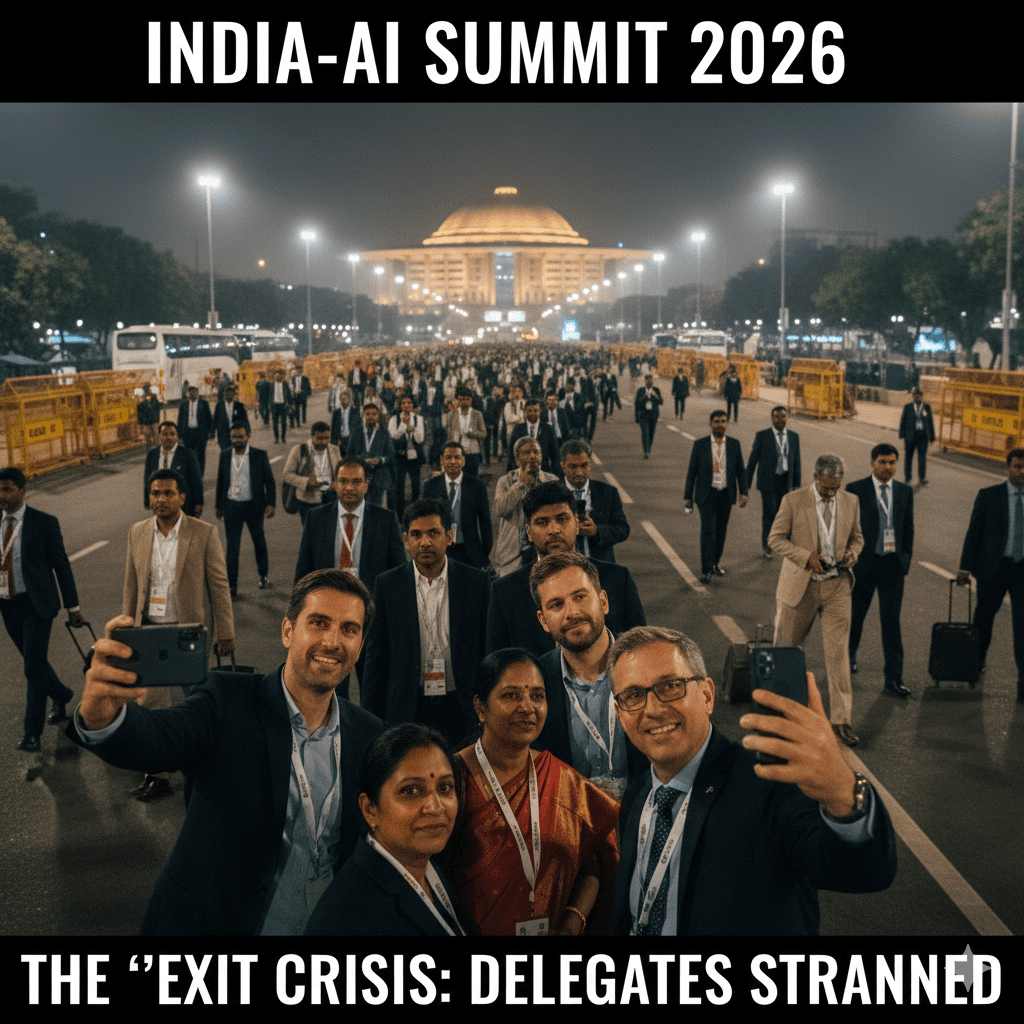
The Logistics Failure: Around 7:40 PM, a “logistics breakdown” occurred due to VVIP movements, specifically for Prime Minister Modi’s arrival preparations for Day 4.
The Result: Hundreds of high-level delegates, including international visitors and tech executives, were stuck. With roads closed and no shuttle services running, delegates had to walk several kilometers to find transport.
The Reaction: Canadian influencer Caleb Friesen shared a viral video of the “long walk,” sparking a national debate about the “last-mile” management of major events in India.
Summary of Day 3 Outcomes
Academic Rigor: Over 250 research papers from Africa, Asia, and Latin America were presented, showing that the Global South is a creator, not just a consumer, of AI.
Infrastructure Sovereignty: The Google “Connect” project indicated a shift toward India becoming the data hub of the Southern Hemisphere.
The Reality Check: The logistics chaos reminded organizers that, while AI is advanced, “Physical Infrastructure” and planning still require human accuracy.
Sarvam builds models customised for India
The Bengaluru-based startup announced two models at the Summit 2026 in New Delhi—a showcase for Prime Minister Narendra Modi’s efforts to make his country a leading player in the emerging technology.
Sarvam’s AI models are built to be used through voice commands and are accessible through 22 Indian languages, which the company says will be a competitive advantage in the country of 1.45 billion where the vast majority can’t read, write or type in English
AI adoption in the Global North is roughly twice of the Global South and the gap is widening, Microsoft Vice Chairman and President Brad Smith said at Summit 2026 in New Delhi on Wednesday.
“The Summit rightly has placed this challenge at the centre of its agenda,” according to a blogpost by the Windows operator.
“For more than a century, unequal access to electricity exacerbated a growing economic gap between the Global North and South. Unless we act with urgency, a growing AI divide will perpetuate this disparity in the century ahead.
IT secretary on Galgotias fiasco
“We want genuine exhibitors at the expo. We don’t want controversy around exhibits here,” Singh said. “Plagiarism, misinformation cannot be encouraged. This should not overshadow the wonderful exhibits others have put out.”
“The main problem is they claimed to be something they are not. They misled. The whole world is here!”
To be sure, the Made-in-China Robodog is no longer at the stall of Galgotias University. In fact, the institute has been told to pack up and move out of the event.
Expo extended by one more day
The Summit is being held at the Bharat Mandapam across 10 arenas covering 70,000 square metres, includes delegates from a myriad countries and the who’s who of the AI world.
“Expo will not be open to the public on 19 February 2026 due to VIP movement,” Krishna said during a press conference on Wednesday.
Due to security reasons, Thursday’s sessions can only be attended by invitees. All sessions will be streamed online. No public will be allowed at Bharat Mandapam on Thursday, 19 February
Nvidia explains Jensen Huang’s absence
Nvidia CEO Jensen Huang could not make it to the Summit as he has caught a bug after three weeks on incessant travel, South Asia MD Vishal Dhupar said.
“Aren’t we all missing Jensen? Everywhere I’m going, everyone is asking (about) Jensen,” he said. “Jensen has travelled for three straight weeks, he caught a bug, he is under the weather.”
“We hope he is well soon, but we are delighted that we have Jay Puri leading a delegation to India and celebrate this very important week where the Summit will demonstrate the power of India.
Summit Showcases Value of Inclusive Global South Dialogue
On the third day of the Summit 2026, the session on “Governing Safe and Responsible within Digital Public Infrastructure (DPI)” brought together global leaders and experts to examine how artificial intelligence can be embedded in public systems in ways that are safe, accountable and inclusive.
As digital public infrastructure increasingly underpins service delivery across health, education, social protection and public administration, the session underscored that systems integrated into these frameworks shape decision-making, allocation of resources and the exercise of rights at scale. In such contexts, trust, legitimacy and accountability were framed not as technical add-ons, but as foundational principles of governance.
Alar Karis, President of the Republic of Estonia, praised India’s leadership in digital public infrastructure, stating it’s shaping the global conversation on technology, governance, and inclusion. Emphasising the structural role of DPI in modern state capacity, H.E. Alar Karis, President of Estonia, said “Digital public infrastructure is no longer just a technical backbone for service delivery; it is a foundation of how modern states operate. When AI is embedded into these systems, algorithmic transparency and human oversight are not optional additions; they are essential conditions for public trust and legitimacy”.
Union IT Minister Ashwini Vaishnaw reiterated that India’s approach remains grounded in practical applications. Addressing a research symposium at the summit, he stated that the country is prioritising enterprise productivity and solutions to large-scale societal challenges. “We, in India, are very focused in the edge, for use cases, for solving real-world problems,for improving the productivity in the enterprises, for population-scale problems like healthcare, like agriculture, like climate change. These are things we are focussed on here in India.
And the submit brings that opportunity,” he said. The global corporate presence was equally notable. Microsoft announced that it is on track to invest $50 billion by the end of the decade to expand access across the ‘Global South’—a term referring to emerging and lower-income nations, many located in the southern hemisphere. The technology giant had previously unveiled $17.5 billion in related investments in India last year, strengthening its footprint in one of the world’s fastest-growing digital markets.
However, the summit has not been without controversy. Galgotias University was reportedly asked to vacate its expo stall following backlash over a robotic dog displayed under the name “Orion.” Critics alleged that the machine was in fact a Chinese-made Unitree Go2 device rather than an in-house innovation, sparking debate over technology representation and intellectual transparency.
The event had already faced criticism on its opening day over logistical disruptions. Minister Vaishnaw had apologised for the inconvenience experienced by attendees, while Congress president Mallikarjun Kharge criticised the government for what he termed “utter chaos and rank mismanagement.”
.