

On February 1, 2026, Finance Minister Nirmala Sitharaman presented her ninth consecutive Union Budget. This marks a significant moment in India’s fiscal history. Focusing on the theme of “Yuva Shakti” (Youth Power) and following the Three Kartavya (Duties) framework of Growth, Inclusion, and Resilience, the Budget 2026-27 lays out a plan for a “Viksit Bharat” (Developed India).
The total expenditure is set at ₹53.47 lakh crore, which includes a historic investment in infrastructure of ₹12.2 lakh crore.
1. Macro-Economic Snapshot & Fiscal Deficit
The government maintains its commitment to fiscal responsibility, balancing increased spending with debt management.
Total Budget Size: ₹53,47,315 crore (7.7% increase from FY25).
Fiscal Deficit Target: 4.3% of GDP (down from 4.4% last year).
Nominal GDP Growth: Estimated at 10% for FY27.
Debt-to-GDP Goal: Aimed at 50% by 2031 (currently 55.6% for the Central Government).
Transfer to States: ₹26.2 lakh crore (a 12.2% increase), including ₹1.85 lakh crore in interest-free loans for capital projects.
2. Personal Finance & Taxation
The main change is the introduction of the New Income Tax Act, 2025, effective from April 1, 2026, which replaces the 1961 code
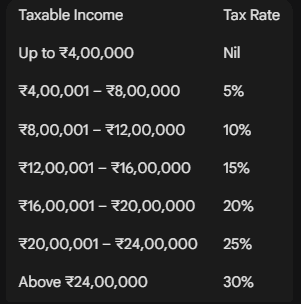
with a simpler, modern framework.
New Tax Regime Slabs (FY 2026-27)
The main tax brackets remain the same as last year, but the administrative burden has been reduced.
Key Reliefs:
– Standard Deduction: Remains at ₹75,000 for salaried employees.
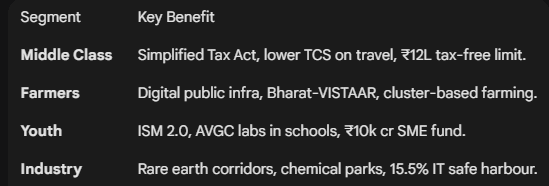
– Effective Tax-Free Limit: Thanks to Section 87A rebates, individuals with a total income up to ₹12 lakh (or ₹12.75 lakh for salaried) pay no tax.
– TCS Reduction: Tax Collected at Source on overseas tour packages and education/medical remittances (over ₹10 lakh) has dropped from 5%/20% to 2%.
– MACT Exemption: Interest awarded by Motor Accident Claims Tribunals is now fully exempt from tax in budget.
3. Infrastructure & Transport: The “Growth Connectors”
Infrastructure is still the main driver of the economy. The PM Gati Shakti plan has been expanded to cover in budget
–
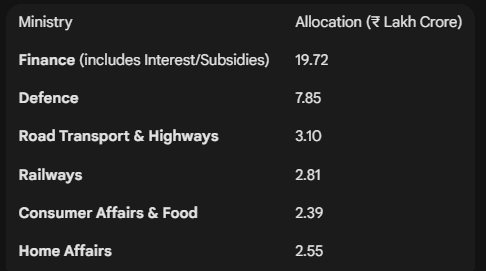
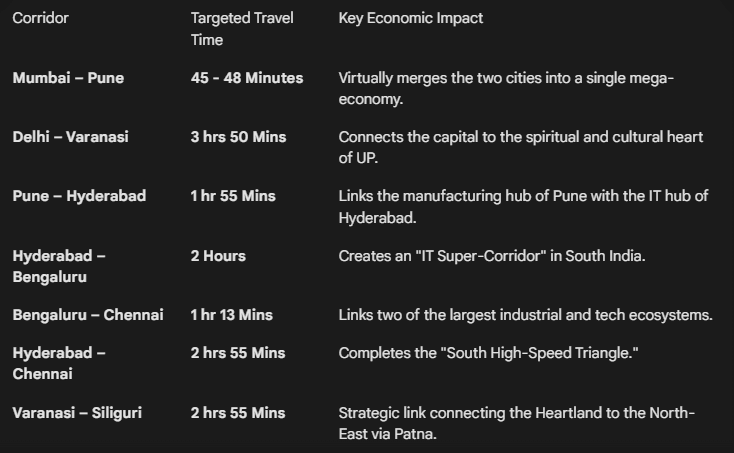
Railways: Allocation of ₹2.81 lakh crore, with a focus on seven High-Speed Rail Corridors (like Mumbai-Pune, Delhi-Varanasi, Hyderabad-Bengaluru).–
Freight: A new Dedicated Freight Corridor (DFC) connecting Surat (West) to Dankuni (East).– Waterways: 20 new National Waterways will be operational soon.–
Urban Development: Mapping of City Economic Regions (CERs) with ₹5,000 crore allocated for each region to improve Tier-II and Tier-III cities.
4. Manufacturing & Technology 2.0
Budget shifts towards advanced technologies to improve India’s position in the global market.
– Semiconductors: Launch of India Semiconductor Mission (ISM) 2.0 with an increased budget of ₹40,000 crore budget.
– Rare Earth
Corridors: Set up in Odisha, Kerala, Andhra Pradesh, and Tamil Nadu to secure minerals for electric vehicles and electronics.
– Biopharma SHAKTI: A ₹10,000 crore initiative to make India a global hub for biopharma, including 1,000 new accredited clinical trial sites.
– Chemical Parks: Three dedicated chemical parks per state using a “plug-and-play” cluster model.
5. Support for MSMEs & The “Orange Economy”
To support small and medium enterprises (SMEs), the government launched several liquidity and mentorship initiatives:
– SME Growth Fund: A ₹10,000 crore fund to help small industries with equity support.
– Corporate Mitras: A group of professional mentors in Tier-II/III towns to assist MSMEs with compliance and finance.
– Mahatma Gandhi Gram Swaraj: An initiative to modernize Khadi, handlooms, and handicrafts.
6. Social Sector: Health, Agriculture & Education
Healthcare: Allocation of ₹1.07 lakh crore, focusing on cancer care (17 drugs exempted from customs duty) and mental health infrastructure.
Agriculture: ₹1.40 lakh crore. Introduction of Bharat-VISTAAR for agri-tech and climate-resilient farming.
Education: ₹1.39 lakh crore. Creation of five University Townships and “Content Creator Labs” in 15,000 secondary schools for gaming and audiovisual sectors.
The Railway Revolution: 7 High-Speed Corridors
The Ministry of Railways received a record allocation of ₹2.93 lakh crore. A key feature is the announcement of seven High-Speed Rail (HSR) Corridors, called “Growth Connectors,” which aim to cut travel time between major economic centers to under 2-4 hours.
Business & Corporate Taxation:
The 2026 Shift
The Budget introduced the Income Tax Act, 2025, which simplifies the 60-year-old law by reducing its size by 50%.
Major Changes for Corporates & Startups:
– Share Buybacks: The tax on buybacks has shifted from companies to shareholders.
–
Small Shareholders: They benefit from being able to use the ₹1.25 lakh LTCG exemption.
–
Promoters: They face a higher effective tax of 22% (Corporate) or 30% (Individuals) to avoid tax loopholes.
–
Minimum Alternate Tax (MAT): Reduced from 15% to 14%, it is proposed to be a “Final Tax.” Companies moving to the New Tax Regime can set off accumulated MAT credit (up to 25% of normal tax liability).
– IFSC Units: Business income for units in GIFT City/IFSC will be taxed at a flat 15% (down from 22/30%) after their tax holiday.
– Safe Harbour for IT: The threshold for IT services safe harbour has been raised from ₹300 crore to ₹2,000 crore, with a common margin of 15.5%.
Financial Markets & Speculation
To curb excessive speculation in the derivatives market, the government has raised the Securities Transaction Tax (STT):
– Equity Futures: Increased from 0.02% to 0.05%.
– Equity Options: STT on the premium increased from 0.1% to 0.15%.
Frontier Tech & Strategic Sectors
The government is positioning India to take the lead in advanced technologies through several new initiatives:
– India Semiconductor Mission (ISM) 2.0: An outlay of ₹40,000 crore to shift from assembly (OSAT) to full-scale production.
– Rare Earth Corridors: A strategic approach to secure minerals like Lithium and Cobalt, reducing reliance on China.
– Data Center Tax Holiday: Foreign cloud providers will enjoy a tax holiday until 2047 if they utilize Indian data centers for global services.
– Biopharma SHAKTI: A ₹10,000 crore fund to enhance domestic production of biologics and biosimilars.
Summary of Indirect Tax Changes
The budget concentrates on boosting Indian manufacturing by lowering input costs:
– Cancer Drugs: 17 essential drugs are now exempt from customs duty.
– Critical Minerals: Duty eliminated on machinery used for processing minerals like Lithium and Copper.
– Personal Imports: Customs duty on personal goods imported via courier/post reduced from 20% to 10%.
– Electronics: Duty exemptions extended for capital goods used in making Li-ion cells.
Budget at a Glance: “Where the Money Comes From”
For every ₹1 the government collects:
– Income Tax: 21 paise
– Corporation Tax: 18 paise
– GST: 15 paise
– Borrowings: 24 paise
– Others (Customs, Excise, etc.): 22 paise





1 thought on “BUDGET 2026: The “Growth & Resilience” Blueprint”