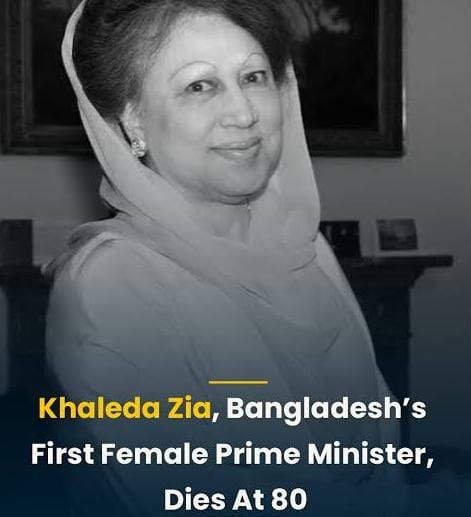
Begum Khaleda Zia, Bangladesh’s First Female Prime Minister, Dies Peacefully in Dhaka at 80
Dhaka, December 30, 2025 — Begum Khaleda Zia, a towering presence in Bangladesh’s political history and the nation’s first female Prime Minister, passed away peacefully early Tuesday morning at Evercare Hospital in Dhaka. She was 80 years old and had been battling a prolonged and complex illness that saw her on ventilator support for the last 30 days of her life, as confirmed by hospital sources and party officials.
Her death, announced by the Bangladesh Nationalist Party (BNP) — which she led for decades — came at approximately 6:00 a.m. local time, just after the Fajr prayers, marking the end of an era in the nation’s modern political landscape.
A Life Defined by Service and Struggle
Born on August 15, 1945, Khaleda Zia entered public life under circumstances that would shape her legacy for decades. She was thrust into national prominence after the assassination of her husband, President Ziaur Rahman, in 1981, who had been a central figure in Bangladesh’s independence and early political developments. His death left a leadership vacuum in the Bangladesh Nationalist Party, and Khaleda stepped forward to carry the mantle.
By 1984 she had become the Chairperson of the BNP, a post she would hold for more than four decades. Under her leadership, the party became one of the two dominant political forces in Bangladesh.

A Trailblazer in Bangladesh’s Democracy
In 1991, Bangladesh held its first widely regarded democratic elections after years of military rule, and Khaleda Zia’s BNP emerged victorious. At 46, she became the first woman to lead the government of Bangladesh, and only the second woman to head a democratically elected administration in a Muslim-majority country — following Pakistan’s Benazir Bhutto.
She served as Prime Minister in two separate terms — from 1991 to 1996 and from 2001 to 2006. Her governments focused on economic reforms, expansion of social services, and educational initiatives like free compulsory primary schooling and support programs for girls.
Though her leadership was not without controversy — including corruption allegations and allegations of political polarization — her supporters credit her with advancing Bangladesh’s democratic institutions at critical junctures.
Final Years: Illness and Political Context
Khaleda Zia’s health had been in decline for several years. She suffered from multiple ailments, including severe liver and kidney complications, heart and chest issues, diabetes, arthritis, and other age-related health challenges.
She was hospitalized in Dhaka on November 23, 2025, after suffering breathing difficulties and related complications. On December 11, her condition worsened and she was placed on ventilator support. Despite concerted medical efforts, including consideration of a possible transfer abroad for treatment, doctors deemed her too unstable to travel.
Her passing comes at a crucial political moment — just weeks ahead of Bangladesh’s national elections scheduled for February, where her son, Tarique Rahman, returned from more than a decade in exile to contest leadership of the BNP and key parliamentary seats.
Nation in Mourning: Official Response and Public Grief
News of her death triggered an outpouring of grief across Bangladesh. Thousands gathered at the hospital and BNP offices in Dhaka, with party officials and supporters holding prayers and vigils.
The government announced three days of state mourning and a general holiday on the day of her funeral, reflecting her stature as a national leader.
Political leaders and dignitaries from around the region also expressed condolences. In India, Prime Minister Narendra Modi paid tribute to her contributions, recalling their past meetings and extending sympathy to her family and the people of Bangladesh.
Cricket legend Shakib Al Hasan and other public figures shared heartfelt messages mourning her departure.

Farewell with State Honors
On December 31, 2025, Khaleda Zia was laid to rest in Dhaka near the tomb of her late husband, Ziaur Rahman, in a ceremony attended by thousands. The emotional send-off, with crowds lining the streets in sorrow and respect, underscored her enduring impact on Bangladesh’s political life.
Her burial beside her husband — a leader of Bangladesh’s independence generation — symbolized the union of two significant chapters in the nation’s history and the legacy they leave behind.
Legacy and Reflection
Begum Khaleda Zia’s life and career were deeply intertwined with the growth and turbulence of Bangladesh’s democracy. She emerged as a symbol of female political leadership in South Asia, a role model for women in politics across the region. Her tenure saw strides in education and social development, even as it faced challenges from fierce political rivalries and accusations of institutional shortcomings.
For supporters, she stood as an uncompromising defender of democratic ideals and the rights of her party’s followers. For critics, her legacy remains more complex — reflective of the sharp political divisions that have long characterized Bangladeshi public life. Her historic role, however, remains undeniable: as the first woman to lead Bangladesh, she carved a place in history that scholars and citizens alike will continue to examine for years to come.