
The 30% Tariff on US Pulses
India has recently imposed a 30% import duty on US pulses, specifically yellow peas. This took effect on November 1, 2025.
“Silent” Retaliation:
India introduced this tariff quietly, without a public announcement. Analysts and geopolitical experts view it as a “silent” retaliatory action in response to the 50% tariffs the U.S. placed on Indian goods earlier in 2025.
Targeting Agricultural States:
The tariff has faced strong criticism from U.S. lawmakers, especially senators from Montana and North Dakota, which are the leading pulse-producing states. They have called on the U.S. administration to prioritize the removal of these “unfair” duties in future trade agreements.
Domestic Justification:
Indian officials argue that the duty is a safeguard to protect local farmers from low-cost imports and to stabilize market prices rather than being aimed solely at the U.S.
The Broader Context:
US-India “Tariff War”
The 30% duty on pulses fits into a larger pattern of trade actions that escalated throughout 2025:
US 50% Tariffs on India (August 2025):
The U.S. raised tariffs on a variety of Indian exports to 50%. This change aimed to penalize India for continuing to buy Russian oil and served as a counter to India’s trade barriers.
Impacted Indian Sectors:
Over half of India’s exports to the U.S., amounting to about $87 billion, are at risk. Sectors that are particularly affected include textiles, gems and jewelry, leather, and automobile parts.
The 500% Penalty Bill (January 2026): In a significant escalation, the U.S. approved a bill that permits tariffs of up to 500% on imports from countries that continue purchasing Russian oil. This action is meant to pressure India.
Economic and Strategic Impact
Trade Imbalance:
The U.S. is India’s largest trading partner, but India recorded a trade deficit of $45.7 billion with the U.S. in 2024. This gap has intensified the U.S. administration’s aggressive trade approach.
Currency Volatility:
Fears about the trade war have contributed to the weakening of the Indian Rupee. Some market forecasts suggest it could reach ₹92 per US dollar in early 2026.
Market Access Conflict: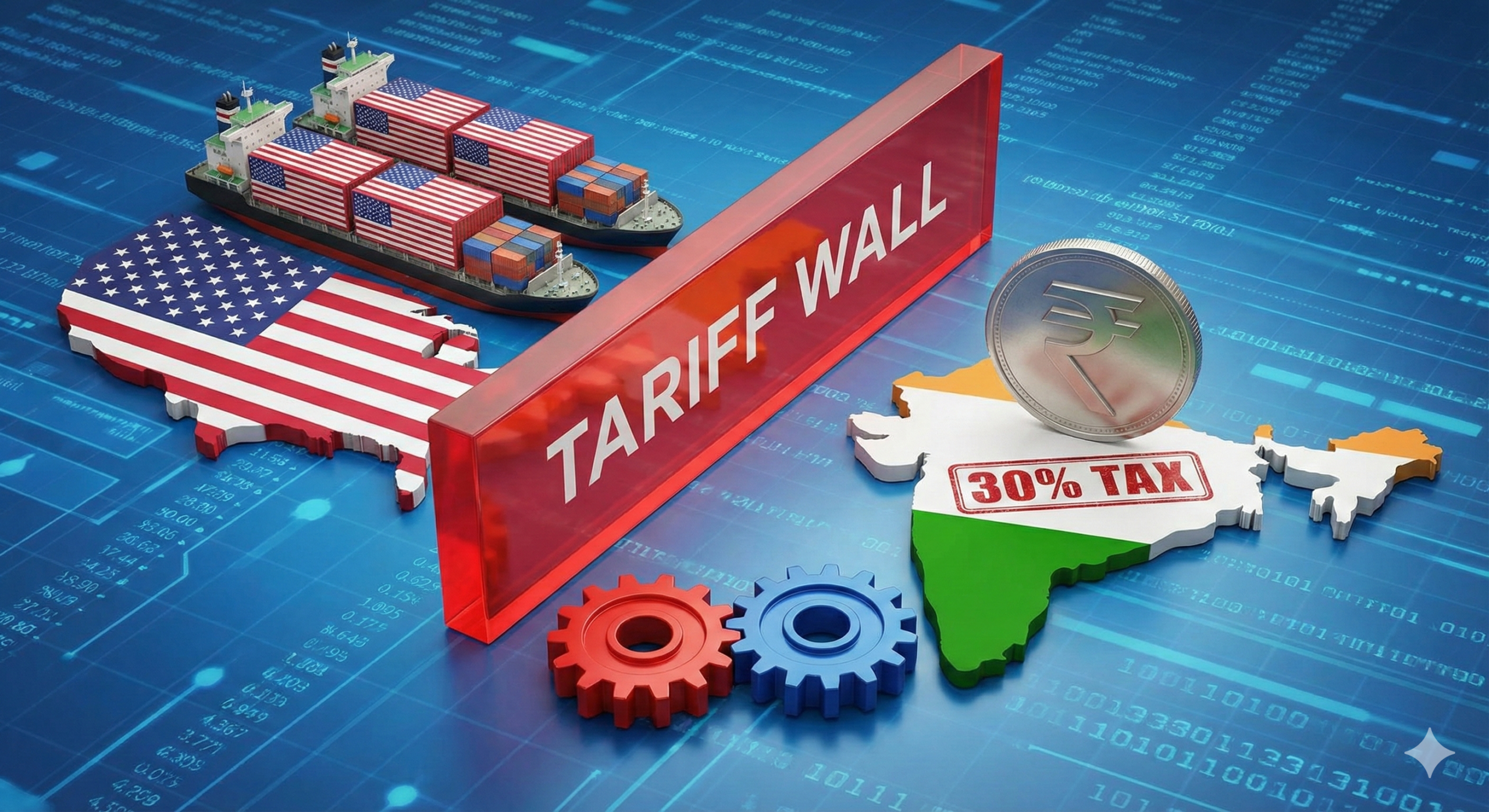
The U.S. is pressing for greater access to India’s agricultural and dairy markets. However, New Delhi considers these areas to be “red lines” that are essential to protect local farmers.
Looking Ahead:
Budget 2026
As India gears up for Budget 2026, Finance Minister Nirmala Sitharaman faces pressure to include financial support and credit guarantees—called “Trump shock absorbers”—to help Indian MSMEs cope with the heavy U.S. duties. Meanwhile, the U.S. Supreme Court is expected to rule in early 2026 on the legality of the IEEPA emergency powers used for many of these tariffs. This ruling could lead to tariff refunds and a reset of trade relations
List of US Pulses Facing 30% Tariff
The tariff mainly applies to yellow peas, but also impacts lentils, chickpeas, and dried beans, which are widely consumed in India. While the duty applies uniformly to all exporting countries, US producers see it as a barrier to a critical market, as India accounts for 27% of global pulse consumption.
List of pulses India imports from US?
In recent years, the US has emerged as a significant supplier of pulses to India.
Yellow Peas
Yellow peas are widely used in soups, snacks, and dals across India. They are valued for their high protein content and smooth texture. After the 30% tariff, prices have risen, pushing importers to consider cheaper sources from Canada and Australia.
Lentils (Red Lentils / Masoor Dal)
Red lentils are a staple in Indian cooking, especially for dals and soups. US lentils are preferred for their large size and consistent quality. The new tariff has increased costs, making lentils from Russia and African countries more attractive tariff 30 %
Chickpeas (Kabuli Chana)
Chickpeas are used in curries, snacks, and international dishes like hummus. American chickpeas are prized for their large size and uniformity. With the 30% tariff, prices have surged, encouraging importers to source from Canada and Australia.
Dried Beans (Kidney Beans, Black Beans, etc.)
Dried beans are used in dals, salads, and processed foods in India. US beans are popular for their consistent size and quality. The tariff has raised prices, reducing their competitiveness against beans from other countries.
Why Did India Impose 30% Tariff on US Pulses?
India’s move is rooted in domestic agricultural policy aimed at protecting farmer incomes and stabilising pulse prices. Duty-free imports of yellow peas were allowed until March 31, 2026, but rising imports caused domestic prices to fall. The 30% duty is designed to support local farmers while managing market supply tariff
US Lawmakers Raise Concern on 30% Tariff on US Pulses
Some US senators have urged President Donald Trump to make pulse market access a priority in trade discussions. They argue that the tariff disadvantages American farmers and undermines the spirit of a fair trade relationship between the two countries.
How Will This Impact the US–India Tariff Trade Deal?
The tariff adds a new complication to the long-pending US–India trade agreement, which has been under negotiation for nearly a year. While both sides want to expand trade and reduce barriers, disagreements over tariffs, agricultural access, and digital trade rules have slowed progress 30%
CONCLUSION
India’s decision to impose a 30% import tariff on pulses originating from the United States has added a new layer of complexity to one of the world’s most important agricultural trade relationships. While pulses may appear to be a niche commodity in global trade discussions, they sit at the intersection of food security, farmer protection, inflation control, and geopolitics for both nations. According to the latest US export data & pulses export data of the USA, the total value of US pulses exports to India reached $80.21 million in 2024, a 39% increase from the previous year. According to the US-India trade data, the US exported pulses worth $4.19 million to India in the first three quarters of 2025.
India is the world’s largest producer, consumer, and importer of pulses, while the United States is among the 4th largest pulses exporter & global exporter of peas, lentils, and dry beans, as per the global trade data. Any tariff change between the two, therefore, carries implications far beyond bilateral trade numbers. It affects global pulse prices, farmer incomes, alternative sourcing patterns, and the broader tone of US-India trade negotiations. While pulses rarely dominate headlines compared to oil, semiconductors, or defense equipment, this move has triggered political reactions in the US, trade recalibrations in India, and price signals across global pulse markets.
What makes this development notable is not just the tariff itself, but who is reacting to it and why. Senators from major US pulse-producing states such as North Dakota and Montana have formally urged former US President Donald Trump to intervene directly with Indian Prime Minister Narendra Modi, highlighting the growing economic pressure on American farmers. This article examines why India imposed the tariff, how the US-India pulse trade has evolved, what the data reveals about import dependence and export exposure, and what this policy shift means for 2025 and beyond.